Share
Climate risk is entering security conversations. What this means for SRM.
 ‌ ‌ ‌ ‌ ‌ ‌ ‌ ‌ ‌ ‌ ‌ ‌ ‌ ‌ ‌ ‌ ‌ ‌ ‌ ‌ ‌ ‌ ‌ ‌ ‌ ‌ ‌ ‌ ‌ ‌ ‌ ‌ ‌ ‌ ‌ ‌ ‌ ‌ ‌ ‌ ‌ ‌ ‌ ‌ ‌ ‌ ‌ ‌ ‌ ‌ ‌ ‌ ‌ ‌ ‌ ‌ ‌ ‌ ‌ ‌ ‌ ‌ ‌ ‌ ‌ ‌ ‌ ‌ ‌ ‌ ‌ ‌ ‌ ‌ ‌ ‌ ‌ ‌ ‌ ‌ ‌ ‌ ‌ ‌ ‌ ‌ ‌ ‌ ‌ ‌ ‌ ‌ ‌ ‌ ‌ ‌ ‌ ‌ ‌ ‌ ‌ ‌ ‌ ‌ ‌ ‌ ‌ ‌ ‌ ‌ ‌ ‌ ‌ ‌ ‌ ‌ ‌ ‌ ‌ ‌ ‌ ‌ ‌ ‌ ‌ ‌

View this email in your web browser.

The 360

Stories, studies, and trends shaping SRM this month

February 2026

A soldier prepares to launch a drone during the multi-national military ICEX 2016 training exercise in the Arctic Circle. ZUMA Press Wire via Reuters Connect

This month we dive into the complex question of how solar geoengineering might affect global security. SRM could reduce some of the risks from climate change, but what additional tensions might it introduce? Explore our new Primer and Perspective piece, and join us for a Live Discussion with three leading experts. 

Read the primer

New from SRM360

Different Takes: Should SRM Be Seen as a Serious Security Issue?


Read the perspective from Burgess Langshaw Power, Josh Horton, Olaf Corry and David Keith.

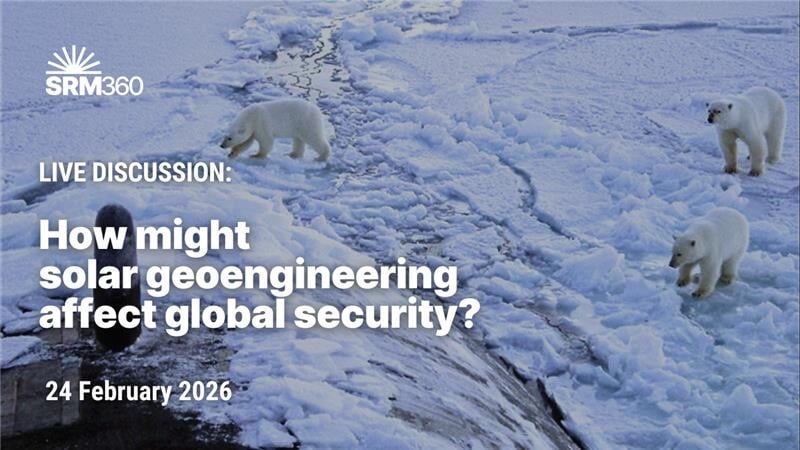
Live Discussion: How Might Solar Geoengineering Affect Global Security?


Register for next week's discussion.

Why Research Space-Based Sunlight Reflection?


Read the perspective from Planetary Sunshade Foundation's Morgan Goodwin.

Mixed-Phase Cloud Thinning


Read the explainer.

Towards a Roadmap for Sunlight Reflection Research


Read the perspective from Reflective's Alistair Duffey.

This month in SRM

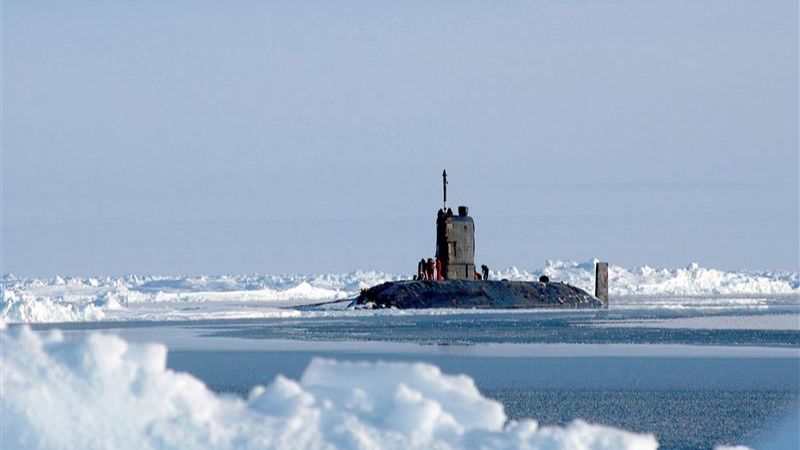
British Royal Navy submarine HMS Tireless surfaces at the North Pole. ZUMA Press Wire via Reuters Connect

Our read


As climate tipping points are increasingly framed as national security risks, governments may begin evaluating SRM through a very different lens. Iceland's classification of AMOC collapse as a security threat illustrates how abrupt climate shocks could shift SRM from a long-term climate debate into a contingency planning question. That framing would also expand who participates in decisions, bringing defence and geopolitical actors into discussions traditionally led by scientists and environmental policymakers. 

Climate risk as security risk


In The Guardian, UN climate chief Simon Stiell warned that national security strategies that ignore climate change are “dangerously narrow”, emphasising that climate impacts are already contributing to famine, displacement, and conflict.


He made the remarks ahead of the recent Munich Security Conference, where climate ultimately received relatively limited attention compared with military spending and geopolitical tensions. Security expert Beatrice Mosello argued that this needs to change in a piece for Chatham House.


Expert views on climate security risks are shifting

A new global foresight survey by the Atlantic Council found fewer experts now expect climate change to be the single biggest threat to global prosperity in the next decade. However, environmental pressures remain deeply intertwined with security risks – with nearly two-thirds of respondents anticipating conflict over freshwater resources within that timeframe.


Climate governance shifts reshape the policy landscape

In the United States, regulators moved to rescind the 2009 “endangerment finding”, the legal foundation for federal greenhouse gas regulation under the Clean Air Act.


While the decision focuses on statutory authority rather than climate science, it could significantly alter US domestic climate governance and signals how political shifts continue to reshape the broader policy environment for long-term climate risk management.


AMOC stability enters the security conversation, and so does SRM


Iceland formally designated a potential collapse of the Atlantic Meridional Overturning Circulation (AMOC) as a national security risk, with experts lobbying for solar geoengineering to be included in the conversation. AMOC is the vast system of ocean currents that moves heat around the Atlantic Ocean and regulates climate across the Northern Hemisphere; its disruption would mean severe and prolonged cooling across northern Europe, significant sea level rise along the North Atlantic coast, and widespread changes to precipitation patterns.


A Nordic Council of Ministers report also concluded that research into climate intervention technologies – and their governance – should continue alongside mitigation as part of a serious response to AMOC overshoot risk.


Could solar geoengineering help stabilise this critical ocean current system? We'll explore that question in a live discussion next month. Sign up for our events list to stay informed.


Early intervention research in the Arctic 


Research aimed at slowing Arctic sea ice decline is taking two forms: modelling-based exploration and early field testing.


Ocean Visions has awarded funding to six projects through its Arctic Sea Ice Restoration Research Fund, exploring approaches to slow or reverse summer sea ice loss – including marine cloud brightening and mixed-phase cloud thinning.


And recently, ARIA-funded teams from Real Ice and Arctic Reflections began fieldwork in Cambridge Bay, Nunavut, pumping seawater onto existing winter ice surfaces – with community consent – to test whether artificially increasing ice thickness can delay summer melt.


Learn more with our Outdoor Experiments Tracker.


The pollution paradox

Buildings and houses stand shrouded in smog, as authorities ordered traffic restrictions due to air pollution in Mexico City, Mexico, February 17, 2026. REUTERS/Henry Romero

Air pollution kills millions of people each year. Now, research is showing that the very policies saving lives by cleaning it up may be contributing to global warming. 


Berkeley Earth's 2025 report highlighted the role played by reductions in sulphur aerosol pollution in recent spikes in global temperatures. Sulphur emissions added reflective particles to the atmosphere; as these are reduced, the unintentional cooling effect they provided is being lost, inadvertently accelerating warming.


Recent studies add context to how aerosol pollution – and its removal – shapes climate systems. Smith et al. report that sulphur dioxide reductions in China have had measurable effects on both global air pollution and the Earth's energy balance. And Sun et al. find that elevated air pollution in early-20th-century Europe played a significant role in driving changes to the Asian summer monsoon.


SAI and air quality 

Sulphate is the most researched particle for SAI – and also a known pollutant that can be harmful at sufficient concentrations. Wang et al. modelled SAI's effects on air quality and found that the particles themselves had minimal direct impacts in their simulations. Regional air quality changes could still arise, but the study attributes these to shifts in rainfall and wind patterns rather than the aerosols directly.


We explored the intersection of SRM and pollution in our article: Could SAI Replace the Lost Cooling Effect From Cleaning Up Air Pollution?


Coral reefs: compounding pressures


Further illustrating the pollution paradox, a study by Ryan et al. finds that 2020 shipping fuel regulations, by reducing sulphur emissions, may have increased heat stress on corals in the Great Barrier Reef by up to 10%, exacerbating bleaching events.


These findings come as scientists warn that extreme marine heatwaves are already pushing reefs toward tipping points – with a recent global assessment finding that a three-year heatwave between 2014 and 2017 bleached more than half of the world’s coral reefs and significantly reduced their recovery capacity.


We took a closer look at the impact of climate change on corals – and whether solar geoengineering could play a role in protecting them in a live discussion last month. Watch the recording.


Opportunities to further SRM research and governance 


Reflective is seeking proposals to deepen understanding of how SAI interacts with Earth system tipping points and climate impacts. Projects are intended to support fast-paced research that can be completed  ahead of the IPCC's Seventh Assessment Report literature review – a tight but meaningful horizon.


The Nuffield Council on Bioethics, meanwhile, has launched a call for evidence as part of its ethical review of SRM, focusing specifically on how to account for the interests of non-human species, the environment, and future generations in policy and decision-making.


Upcoming events


Stay informed about SRM workshops, webinars, and conferences.

Browse events

Follow our updates and subscribe to our weekly insights.

Thank you for reading.

Receive this newsletter from a friend and want it in your inbox? Subscribe.

Share your feedback

Email Marketing by ActiveCampaign